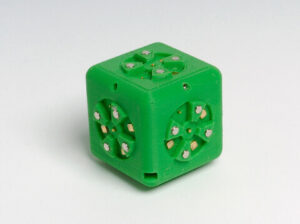
How does magnetic attraction force change when you substitute steel for one of the magnets?
Our roBlocks prototype (above) uses seven tiny magnets on each face of each cube. On each connector, there are protruding keys (with silver cylinder magnets)
Our roBlocks prototype (above) uses seven tiny magnets on each face of each cube. On each connector, there are protruding keys (with silver cylinder magnets)

Last weekend I got to play with an amazing group of people at a two-day workshop in Boston. It was called Programming Reality: From Transitive Materials


Research and development at Modular Robotics has been generously funded in part by SBIR grants from the National Science Foundation.

2020
Learning® Magazine Teachers’ Choice℠
Award for the Classroom

2019
Parents’ Choice Recommended Award®

2019
Common Sense Education
Top Pick for Learning

2019
The National Parenting Center
Seal of Approval

2018
STEM.org
Authenticated™ Educational Product
Cubelets FAQs is your place to find answers to common questions about Cubelets robot blocks, orders, and Modular Robotics.
Need help, can't find an answer? Contact the Modular Robotics support team and we'll help you!
Get the details on Modular Robotics shipping policies and sales tax collection for orders in the United States and around the world.
Cubelets are backed by a one year warranty. Need to make a claim, get a replacement, or have questions? Click to get started.
Explore a huge collection of K-12 lessons, activities, guides, training, and more.
Learn everything you need to know to start creating more with Cubelets robot blocks in this handy Getting Started Guide.
Go beyond the building blocks and play with the code inside. Cubelets apps make it easy to create even more with your Cubelets.
There are millions of robots you can create with Cubelets. Check out these robots to help inspire your inventions.